

Before Blooming

As a gift to V de Valentina to congratulate her on the release of “Together is a distant star”, an anthology in which she had the honor of participating and bringing her story to life (and in waiting of my review since I had the pleasure of receiving an ARC), I’ve decided to bring to Substack a translated review of her comic, by the hand of Kara Mokita at illustrating, “Antes de florecer” in spanish, translated to “Before Blooming” in english, published on Webtoon.
Be warned in advance, since I’ll be discussing and analyzing some themes of the story, this might contain some spoilers.
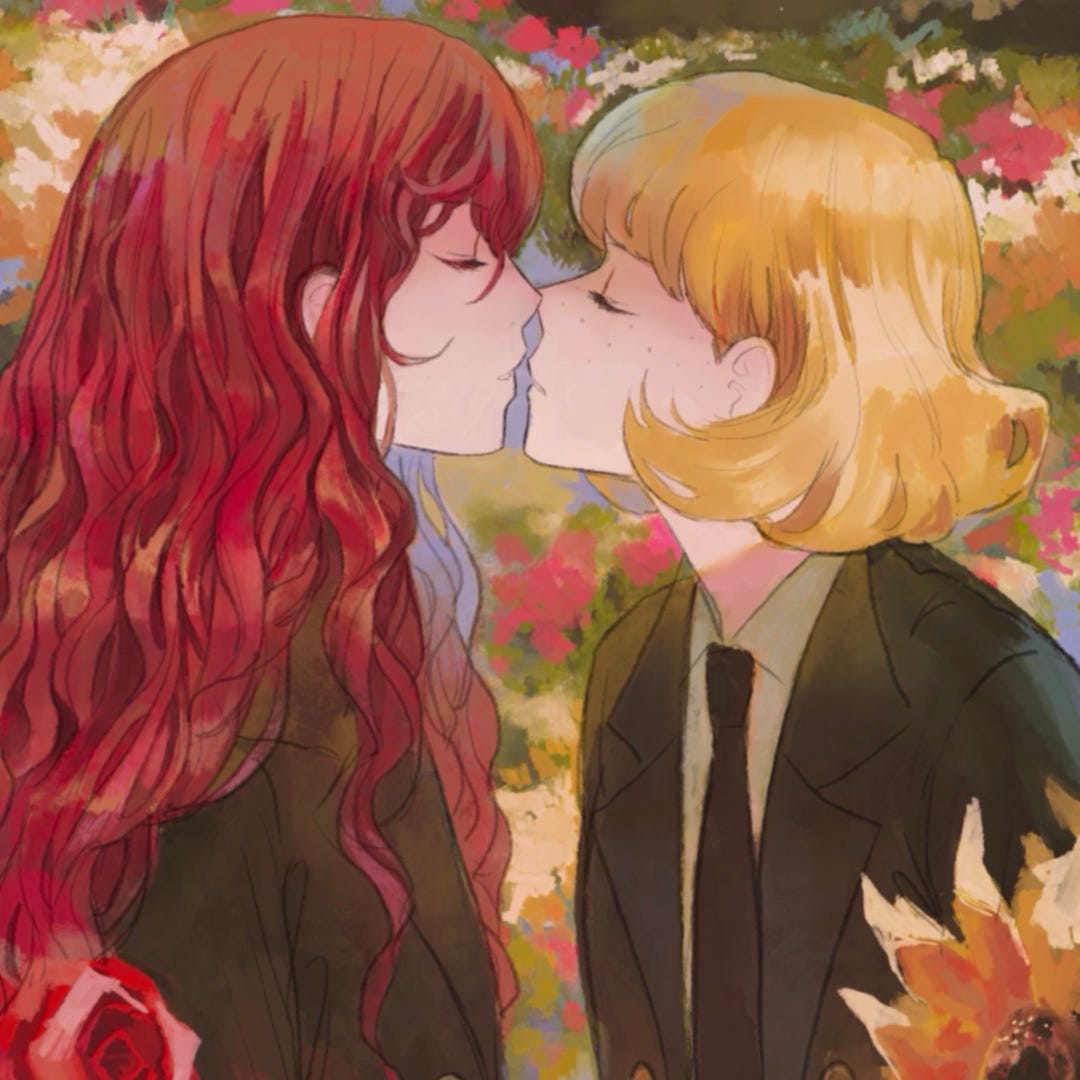
S Y N O P S I S
Sunny is a cheerful student at Greenhouse Academy, a place that teaches her how to blossom. Everything is wonderful; her friends love her dearly, and she has a great time, until she meets the enigmatic Rose. This encounter will change her destiny forever, the beginning of a relationship between two flowers as opposite as night and day. Can the rose and the sunflower escape their respective natures?
Many who have known me for a long time know of my passion for floral themes, including the language of flowers, so as soon as I heard about this story I dove right into reading it and I am already eagerly awaiting for more chapters to clear up any doubts that have stuck with me while reading it.
So far, the plot is really grabbing my attention (and has me in a chokehold, not gonna lie), as well as the diversity of the cast and the potential for future characters to be added (so much so that I’m writing my own fanfiction of this story! I’m really excited to show it to you). The premise is simple, but that doesn’t make it any less compelling, as the dynamics between these little flowers develop.
Just as every rose has its thorn, this comic with its beautiful and colorful art can be deceiving, so pay close attention!

DATA SHEET
Authors:
Platforms:
Reading: Western type (left to right)
Format: Black and white
Status: Ongoing
ART
Karamokita ‘s linework is really and delicate, with a style reminiscent of old-school shoujo manga, having an expressiveness that takes you back to the era of Naoko Takeuchi’s (Sailor Moon) and Io Sakisaka’s (Ao Haru Ride) manga.
The characters have clear silhouettes, with totally recognizable designs (although I admit that at the beginning for my original review it was difficult for me to find Daisy’s name but it was a really small detail), they are also characterizable in their “stereotypes” (or at least, what they appear to be and project to the outside)
The setting at Greenhouse Academy is elegant, with a French baroque architectural vibe, not far removed from yuri academies like Maria-sama ga miteru, Strawberry Panic, and a hint of Ohtori Academy present in Shoujo Kakumei Utena.
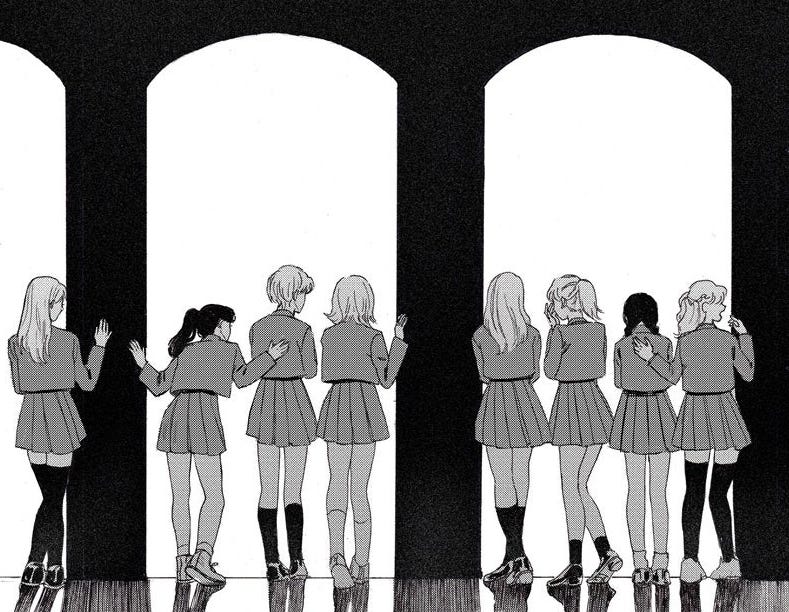
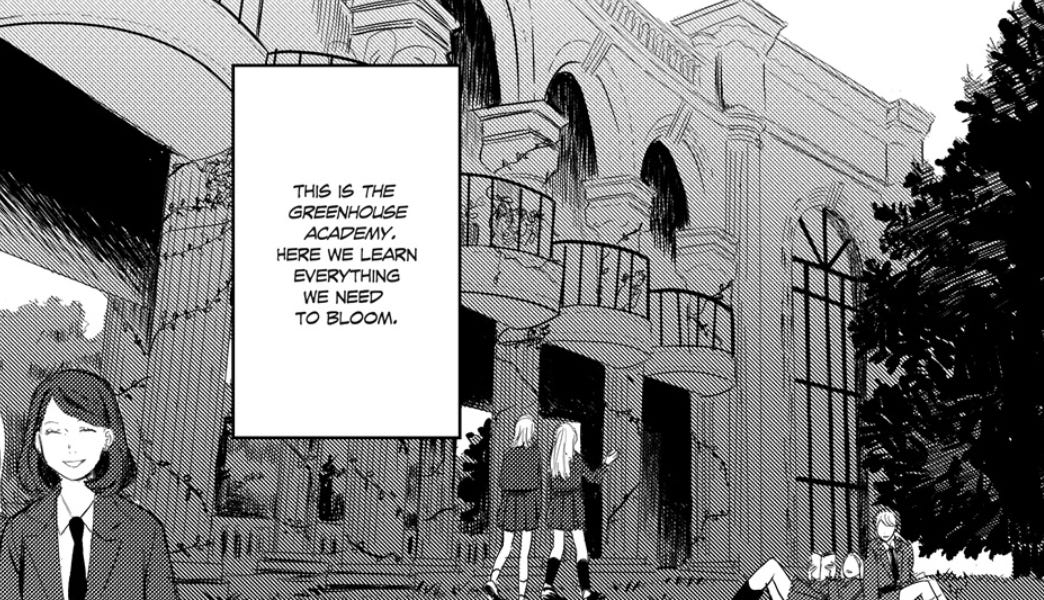
And this is something more on the personal side, but I would like to see more colored illustrations at the start of each new chapter or some official character sheets because I’m very intrigued to see the color palette of the rest of the girls and know what they look like beyond black and white.
CHARACTERS
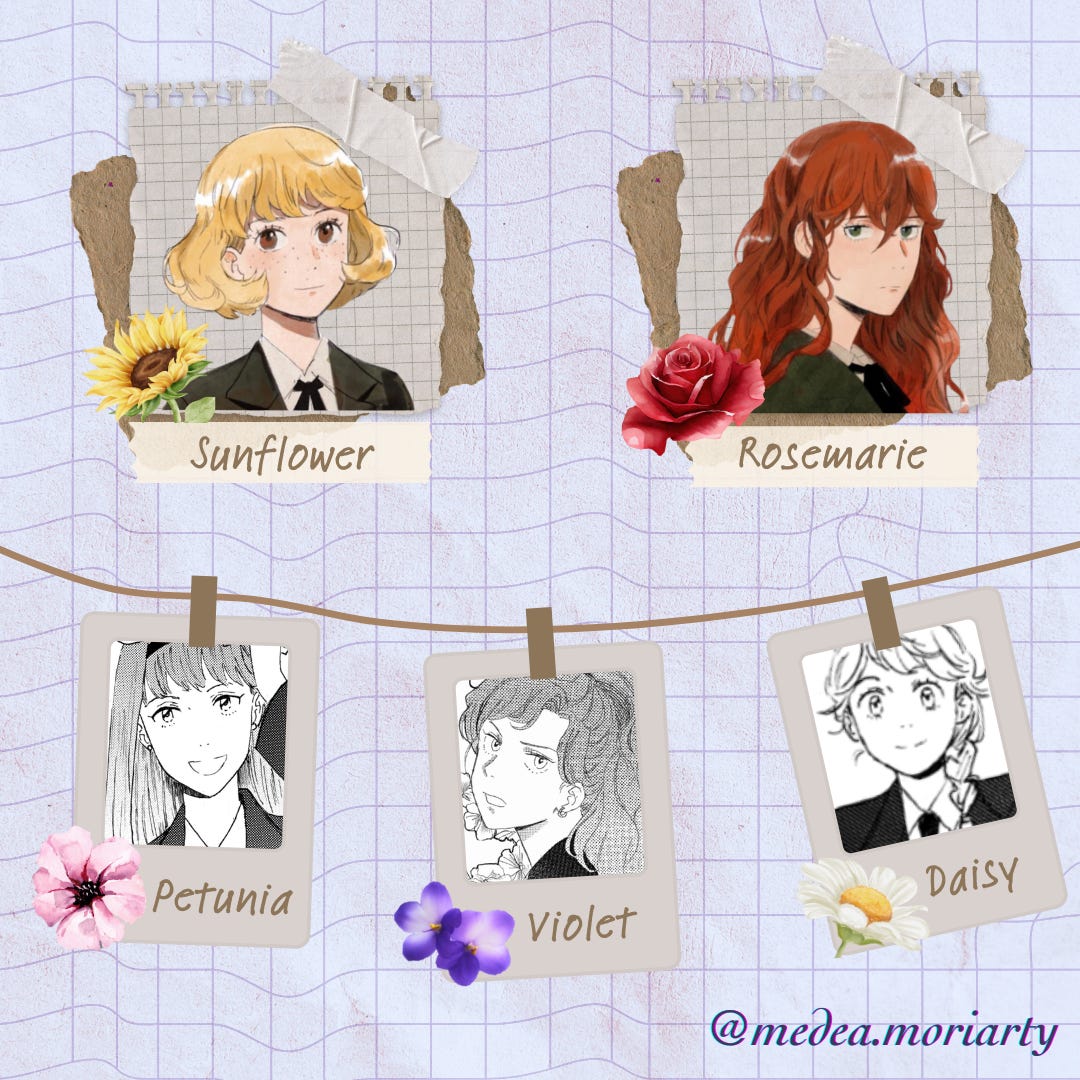
Rosemarie “Rose” (Rose)
The rose of Greenhouse Academy, a lonely soul marginalized by her peers, associated with the reputation of roses as a species: dangerous and intense, not just in behavior, but also with their sharp thorns, made to harm others but also themselves.
In the language of flowers, the rose represents love, beauty, passion, and desire, and also feelings of intense love (especially red roses).
Sunflower “Sunny”
True to her name, this freckled young woman is a ray of sunshine for others, the pampered one of her friends who jumps into action at the first chance to help someone in need. Intrigued by the enigmatic Rosemarie, will she be drawn in by the perfume of this rose or will she end up hurt by its thorns?
In the language of flowers, they carry a bright and joyful message. They represent positivity, longevity, and happiness. In the case of hanakotoba (the Japanese language of flowers), they signify respect, passionate love, and radiance.
Daisy
The reconciling voice of the group, who cares for her friends with a motherly attitude.
In the language of flowers, the daisy represents purity or a return to innocence, youth, or childhood. It can also symbolize new beginnings, and in the case of the hanakotoba, it represents faith.
Petunia
The elegance in person, with a refined and feminine air, she is also part of Sunny’s protection squad.
In the language of flowers it represents anger, resentment, unrequited love, although it can also mean comfort and peace, generally with contradictory meanings, subject to the color of the flower itself.
Violet
Another of Sunny’s friends. She is the one who most openly expresses her misgivings about roses, strongly opposing Sunny and Rose’s closeness.
In the language of flowers, it represents modesty, honesty, humility, loyalty, and fidelity, a serene and discreet beauty thanks to its appearance. It also conveys lasting love and steadfastness, as well as innocence and spiritual wisdom.
Lycoris radiata
We know nothing about her (so far), except that, according to rumors, she was a victim of Rose’s thorns, left badly injured and seen wandering around the Academy with bandages after her hospitalization.
In the language of flowers, it represents death and the fleeting beauty of life, as well as longing. In hanakotoba (traditional Japanese divination), the Higanbana symbolizes oblivion, abandonment, separations, farewells, and life after death, though it also signifies reunions, sad memories, and perseverance in the face of adversity. It can be seen in places associated with death, such as graves.

In this story, you can see a bit of the parallel with the beautiful but dangerous, the “seeing without touching,” and I don’t know if I’m reading too much between the lines (the authors can confirm this for me), but the way the girls describe Rose as someone “dramatic who loves intensely as if you were her whole world“ and that you can’t get rid of her, who then describes herself as “very sensitive”, gives me a lot of vibes of how others might describe someone who suffers from Borderline Personality Disorder (BPD).
Rose normalizes her pain, both physical and emotional, because of her nature as a rose; it’s normal to hurt herself and others with her thorns, something she must get used to and tolerate. She is the one who must take care of her own problems and affairs on her own, without help from anyone else.
It is even Rose herself who participates in assuming and internalizing this harmful stereotype and stigmatization towards roses, where she warns Sunny how dangerous she is and that she should not approach her or she will end up getting hurt. Is this really her own thinking or has she ended up adopting and believing what others say about her?
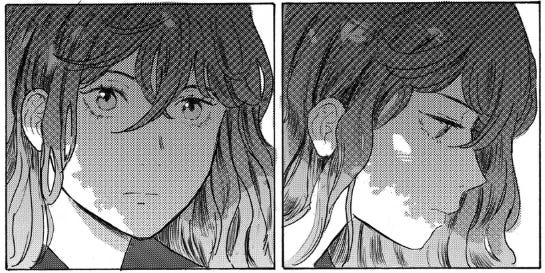
Sunny, on the other hand, is the sunflower, the flower that gazes up at the sunlight without seeing the shadows around her, or so the people around her want to believe, constantly reminding her how absentminded and deep in the clouds she always is. But Sunny also seems to want to see the light and the good in others, which is why from the beginning she’s the one who questions the stereotype about roses. From the start, she’s the one who doubts whether Rosemarie, the rose in front of her, is as terrible as everyone makes her out to be. Even when she sees Lycoris Radiata wounded and bandaged, she continues to question whether if it was really Rose’s fault or if there’s something more behind it. On one hand, she doesn’t pressure Rosemarie, she doesn’t force her; yes, she invades her personal space a bit at the start, but then she maintains her distance. She’s the sun trying to warm the numb Rose.
In contrast, during their first encounter, Sunny’s first instinct is to notice that Rose is bleeding and worry about how painful the wound looks, as well as emphasizing that no flower can survive alone (both in the context of the personified flowers in this story, and flowers in the context of nature, not only do they need other flowers, some even depend on other creatures and environmental conditions to survive and complete their pollination process), and Rose knows this deep down, or she wouldn’t have shown that smile to Sunny.
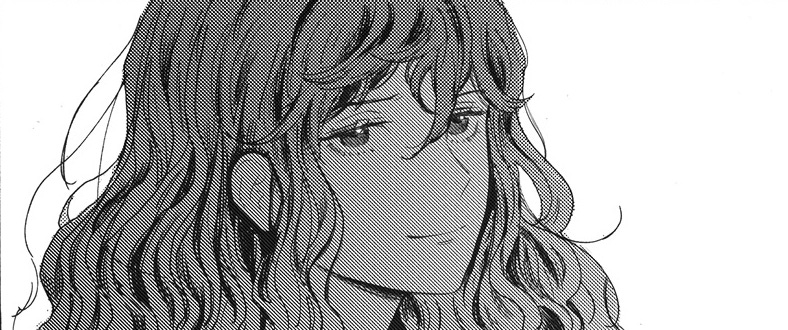
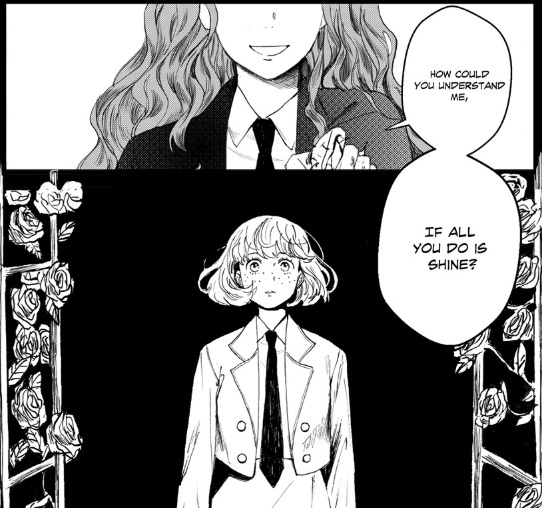
I know I’m taking liberties in this analysis, but that’s the feeling I get as I read it. I think that for someone who has been as stigmatized as Rose, seeing someone as “brilliant” as Sunny creates a bit of a “you’re speaking from a place of privilege, you have everything” feeling, and that’s why she reacts the way we see in the panel where she refers to not being able to understand her situation if all she does is shine.
Later, when Sunny’s friends see her with Rose in the garden, it is Rose who, despite having been enjoying herself minutes before with Sunny, appears visibly uncomfortable, almost guilty or ashamed for having a good time.
It also seems that Sunny’s group of friends, by being very overprotective of her, end up infantilizing her a bit, emphasizing comments like how absentminded she is or implying what they want for her: “You want someone who makes you laugh,” only to then talk about how she needs a healthy and happy relationship, and even insistently bringing up the topic of flower compatibility (in Sunny’s case, with tulips, which they mention are very nice, suggesting she should get to know a classmate from another classroom). But smiles aren’t everything in a relationship, are they? Not to mention that the group perpetuates the stigmatization of Rose and others like her by referring to her as “that rose.” Violet is the most intense about it, to the point that it seems personal, while Petunia only expresses concern for Sunny’s physical safety but doesn’t believe her interest in Rose is genuine, but rather something akin to a savior complex. But what doesn’t change among the girls is their firmness in emphasizing the nature of roses.
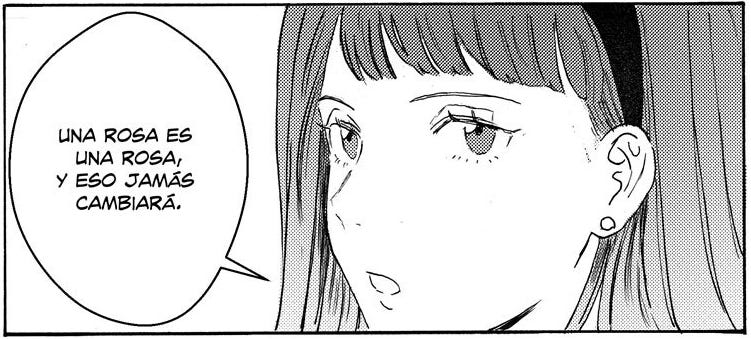
In conclusion, Before Blooming is a story with a simple premise, but with potential for psychological depth in its characters and the dynamics between them, as well as a latent world-building to develop a varied garden with different flowers inside, a story where what you see does not have an absolute truth at the beginning.
Thank you so much for reading! I invite you to subscribe and leave a comment if you enjoyed it!
Thank you so much for translating this review, I'm sure Vale is going to absolutely love it!! I personally loved your analysis of each character and the story 😭💕🔥 🔥 🔥
I love it so much! You're the absolutely best 🥹💕💕💕 thank you for all the support!
Btw I can't wait to read your review of "Together is a Distant Star" 👀